dm_subtrans
Posted: Thu May 06, 2021 8:04 pm
Why Metro? Since childhood, I was attracted by the Soviet metro system, its secrecy, mystery. In those years, the Cold War was going on and the metro on the territory of the Soviet Union was built not only as a transport system, but also as a strategic facility where people could hide during the atomic bombing. When I was younger, I infiltrated the system several times for adrenaline rush and adventure. This map is an opportunity to share a part of the history of my hometown and visit these places not like an ordinary passenger. The map consists of two zones - the first is Khreshchatyk station (Ukrainian: Khreschatyk, is a station on the Sviatoshynsko-Brovarska Line of the Kyiv Metro. The station is named for the Khreshchatyk street, the most central street in Kyiv. The station was opened in 1960 along with the first stage of the Metro. It The station is pylon trivault (architects Yu.Tyahno and I. Maslenkov) that features ceramic Ukrainian ornaments framed by metallic grills on the central hall sides of the pylons.
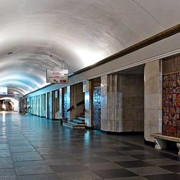


White marble is used elsewhere, particularly for the walls and the main pylon frames. The ceiling is covered in white plaster and lighting comes from hidden lamps in the niches of the central vault and a central row of lamps.
The second zone is Maidan Nezalezhnosti (Ukrainian: Майдан Незалежності) is a station on Kyiv Metro's Obolonsko–Teremkivska line. The station was opened on 17 December 1976, and is named after Kyiv's Maidan Nezalezhnosti (Independence Square) on the Khreschatyk street. It was designed by N. Kolomiiets, I. Maslenkov, M. Syrkyn, and F. Zaremba.
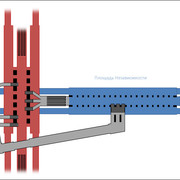
The station was formerly known as Ploscha Kalinina, but was renamed a year after its opening to Ploscha Zhovtnevoi revoliutsii (Ukrainian: Площа Жовтневої революції). Maidan Nezalezhnosti forms a station complex with a transfer section with the neighbouring Khreschatyk station on the Sviatoshynsko-Brovarska Line.
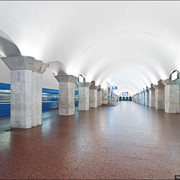

The station is laid deep underground and consists of a central hall with porticoes. The lamps which light the station are hidden in the niches between the columns and the walls.
The depth of each station is about 60m underground

In 1976, the station became the first transfer point in the system to the newly opened Obolonsko–Teremkivska Line's (then named Kurenivsko-Chervonoarmiyska Line) Maidan Nezalezhnosti.
The stations are connected side to side with staircases and an escalator. The original corridor, however, proved to be too short and unable to cope with rising passenger traffics and in 1986 a second, longer corridor connected the opposite sides of the stations allowing traffic to be diverted
P.S. The map is still in beta status. This is my first expirience of building a map and there can be a lot of mistakes.
White marble is used elsewhere, particularly for the walls and the main pylon frames. The ceiling is covered in white plaster and lighting comes from hidden lamps in the niches of the central vault and a central row of lamps.
The second zone is Maidan Nezalezhnosti (Ukrainian: Майдан Незалежності) is a station on Kyiv Metro's Obolonsko–Teremkivska line. The station was opened on 17 December 1976, and is named after Kyiv's Maidan Nezalezhnosti (Independence Square) on the Khreschatyk street. It was designed by N. Kolomiiets, I. Maslenkov, M. Syrkyn, and F. Zaremba.
The station was formerly known as Ploscha Kalinina, but was renamed a year after its opening to Ploscha Zhovtnevoi revoliutsii (Ukrainian: Площа Жовтневої революції). Maidan Nezalezhnosti forms a station complex with a transfer section with the neighbouring Khreschatyk station on the Sviatoshynsko-Brovarska Line.
The station is laid deep underground and consists of a central hall with porticoes. The lamps which light the station are hidden in the niches between the columns and the walls.
The depth of each station is about 60m underground
In 1976, the station became the first transfer point in the system to the newly opened Obolonsko–Teremkivska Line's (then named Kurenivsko-Chervonoarmiyska Line) Maidan Nezalezhnosti.
The stations are connected side to side with staircases and an escalator. The original corridor, however, proved to be too short and unable to cope with rising passenger traffics and in 1986 a second, longer corridor connected the opposite sides of the stations allowing traffic to be diverted
P.S. The map is still in beta status. This is my first expirience of building a map and there can be a lot of mistakes.
